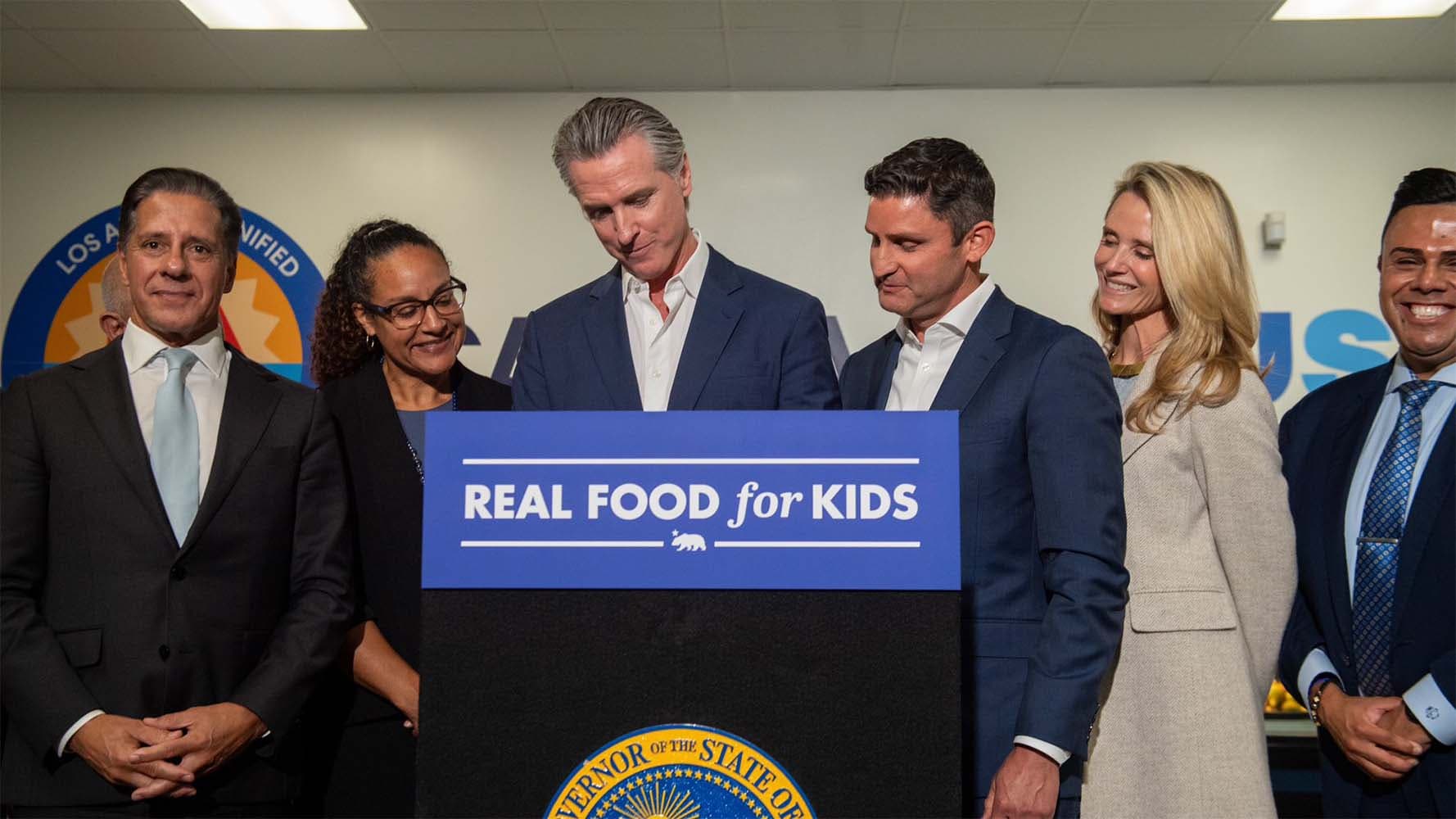
California will require restaurants with 20 or more locations to list major food allergens on their menus starting in 2026. The allergens that must be disclosed include milk, eggs, shellfish, tree nuts, peanuts, wheat, soy, fish, and sesame.
This comes after a separate bill to ban ultraprocessed food in schools (AB 1264). Read more: California bans ultraprocessed food in school lunches
Read: California Is The First In The Nation To Require Allergen Disclosures On Restaurant Menus With SB 68
SB 68 Bill Text
Outlining allergens:
(a)Major food allergen means all of the following:
(1)Milk.
(2)Eggs.
(3)Fish, including, but not limited to, bass, flounder, and cod.
(4)Crustacean shellfish, including, but not limited to, crab, lobster, and shrimp.
(5)Tree nuts, including, but not limited to, almonds, pecans, and walnuts.
(6)Wheat.
(7)Peanuts.
(8)Soybeans.
(9)Sesame.
(10)A food ingredient that contains protein derived from a food listed in paragraphs (1) to (9), inclusive.(b)Major food allergen does not include either of the following:
(1)A highly refined oil derived from a food specified in paragraphs (1) to (9), inclusive, of subdivision (a) and any ingredient derived from that highly refined oil.
(2)An ingredient that is exempt under the petition or notification process specified in the federal Food Allergen Labeling and Consumer Protection Act of 2004 (Public Law 108-282).
How the allergen guide should be presented
(a)Commencing July 1, 2026, a food facility that is subject to Section 343(q)(5)(H) of Title 21 of the United States Code that serves or sells food to the consumer shall provide written notification of major food allergens that the food facility knows or reasonably should know are contained as ingredients in each menu item. The food facility shall provide this information in either of the following manners:
(1)Directly on the food facilitys menu. If the food facility elects to provide major food allergen information directly on its menu, the menu item shall be followed by a written statement below or immediately adjacent to the menu item indicating the major food allergens contained in the menu item.
(2)(A)In a digital format, including, but not limited to, using a quick response (QR) code that links to the food facilitys digital menu.
(2)(B)If a food facility elects to provide the major food allergen information in a digital format, the food facility shall also use an alternative method to provide the information to customers who are not able to access the information in the digital format. For purposes of this subparagraph, alternative method includes, but is not limited to, any of the following:
(i)A separate allergen-specific menu.
(ii)An allergen chart.
(iii)An allergen grid.
(iv)An allergen booklet.
(v)Other written materials.(b)A food facility required to provide major food allergen information pursuant to this section shall use either of the following when providing the information:
(1)Common or usual names of the major food allergens.
(2)Standardized pictograms to communicate the presence of major food allergens.(c)An enforcement agency may utilize either of the following methods to evaluate a food facilitys compliance with this section:
(1)Visual verification of allergen disclosure. An enforcement officer may confirm that required allergen statements are displayed on printed menus, digital menus, or the alternative methods described in subparagraph (B) of paragraph (2) of subdivision (a).
(2)Other reasonable methods of verification consistent with the intent of this section.(d)For purposes of this section, the following definitions apply:
(1)Major food allergen has the same meaning as defined in Section 113820.5.
(2)Menu has the same meaning as menu or menu board, as defined in Section 101.11 of Title 21 of the Code of Federal Regulations.(e)This section does not apply to prepackaged foods that are subject to federal labeling requirements for major food allergens pursuant to Section 343 of Title 21 of the United States Code.
(f)This section does not apply to compact mobile food operations, as defined in Section 113831, or nonpermanent food facilities, as defined in Section 113839.
(g)This section does not alter any duty that a food facility may have under existing law to reasonably ensure the safety of its patrons.
View the CA Legislature page for SB-68 Major food allergens