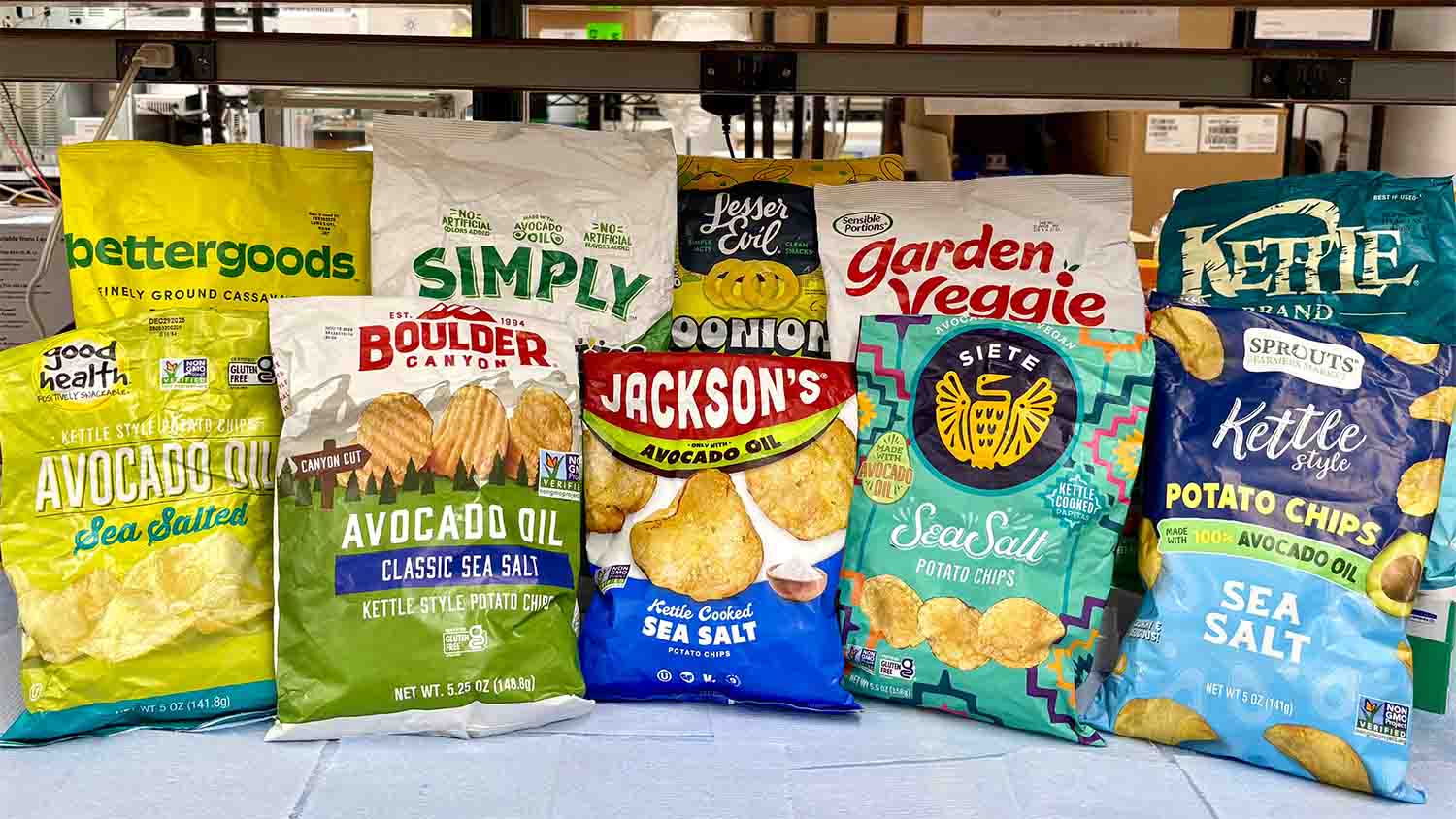
Some of the avocado oil labeled chips tested in Selina Wang's lab at UC Davis. (Natalie Lopez-Alvarez/UC Davis)
The UC Davis Avocado Oil Study: What It Actually Found
UC Davis researchers bought 27 packaged foods that listed avocado oil as their only oil, two production lots of each, and tested all 54 samples. Forty-eight, or 89%, contained oil that did not match avocado oil. This is what the study measured, which products passed, and what its critics say.
What the study tested
The paper is Authenticity of avocado and olive oils used as ingredients in commercially processed foods, published in Applied Food Research and announced by UC Davis on July 15, 2026. It comes from Selina Wang’s lab in the UC Davis Department of Food Science and Technology, with Natalie Lopez-Alvarez as first author. It was paid for internally, out of UC Davis and UC Agriculture and Natural Resources startup funds plus the lab’s discretionary money. The authors declare no competing interests and no industry funding.
The team bought 37 products from California stores and online retailers during 2025 and 2026, 27 labeled with avocado oil and 10 with olive oil, across chips, mayonnaise and salad dressing. Two lots of each were collected and each lot run in duplicate, giving 74 samples: 54 avocado, 20 olive. Every product declared exactly one edible oil on its ingredient list, so a disclosed blend does not explain the results.
Researchers extracted the fat from each product and measured its fatty acid and sterol profiles against the reference ranges in the Codex Alimentarius standard for named vegetable oils (CXS 210), which added avocado oil in November 2024.
The classification criteria allowed for natural variation. A sample could sit up to 10% outside a Codex limit on a single marker and still count as consistent. It could miss on as many as two markers and be called borderline if the rest of the profile looked authentic, and a sample clean on fatty acids and borderline on sterols, or the reverse, was counted as consistent. Only samples with multiple deviations pointing the same way were classified as inconsistent.
These are the Codex ranges for avocado oil the study measured against, as printed in the paper. Fatty acids are expressed as a percentage of total fatty acids, sterols as a percentage of total sterols.
| Marker | Codex range for avocado oil |
|---|---|
| Palmitic acid (C16:0) | 11.0 to 26.0% |
| Palmitoleic acid (C16:1) | 4.0 to 17.1% |
| Stearic acid (C18:0) | 0.1 to 1.3% |
| Oleic acid (C18:1) | 42.0 to 75.0% |
| Linoleic acid (C18:2) | 7.8 to 19.0% |
| Alpha-linolenic acid (C18:3) | 0.5 to 2.1% |
| Brassicasterol | ND to 0.5% |
| Campesterol | 4.0 to 8.3% |
| Stigmasterol | 0.3 to 2.0% |
| Clerosterol | 1.0 to 2.5% |
| Beta-sitosterol | 79.0 to 93.4% |
| Delta-5-avenasterol | 2.0 to 8.0% |
| Delta-7-avenasterol | ND to 1.5% |
Cis-vaccenic acid, which the study found strongly discriminating, is not in the standard.
The team also tested whether processing itself could shift the markers. They fried potato and tortilla chips in retail avocado oil at 180°C, made mayonnaise from scratch, then re-extracted the oil. Major fatty acids moved by less than 0.6 percentage points, and cis-vaccenic acid by 0.1. Emulsifying shifted fatty acids by at most 0.3 points and sterols by 0.5. Clerosterol, which most failing mayonnaises came in under, was unaffected by emulsifying. Delta-7-avenasterol, which many failing chips exceeded, was unchanged by frying.
What it found
Of 54 avocado oil samples, 48 were inconsistent with authentic avocado oil:
- Chips: 26 of 28 samples failed (93%)
- Mayonnaise: 10 of 14 samples failed (71%)
- Salad dressing: 12 of 12 samples failed (100%)
Among the 20 olive oil samples, 1 failed. Olive oil has had international compositional standards since 1981; avocado oil got them in 2024.
The failures shared a pattern: less palmitic, palmitoleic and cis-vaccenic acid, less beta-sitosterol and clerosterol, and more stearic acid, campesterol, stigmasterol, delta-7-stigmastenol and delta-7-avenasterol. That pattern is characteristic of seed oils. Two markers carry most of the signal. Palmitoleic acid, which Codex puts at 4.0 to 17.1% in avocado oil, came in below 4.0% in 47 of the 54 avocado oil samples. Cis-vaccenic acid, which avocado oil carries and most seed oils do not, ranged from 1.1 to 6.5% across the samples and averaged 5.3% in those that passed against 1.7% in those that failed. On the principal component plots, many avocado oil products sat near a supermarket vegetable oil blend of canola, corn, soybean and sunflower. One sample, a bag of Bettergoods Hatch Chile Tortilla Chips sold as fried in 100% avocado oil, measured 52.5% linoleic acid and 24.8% oleic, a soybean oil profile.
The study did not identify which oils were used, or in what proportion. Wang told the Daily Caller that this was outside its scope, and that earlier work from her lab points to high oleic seed oils as common adulterants: “High-oleic sunflower oil and safflower oil have high oleic acid content and can have fatty acid profiles that resemble avocado oil. This is why we also include other analyses, such as sterol profiles, to verify authenticity in our studies.”
Which products passed
The paper codes its samples by number. UC Davis published a media kit naming every product and its result by lot.
| Avocado oil product | Category | Lot 1 | Lot 2 |
|---|---|---|---|
| Bettergoods Hatch Chile Tortilla Chips | Chips | Inconsistent | Inconsistent |
| Boulder Canyon Avocado Oil Classic Sea Salt Kettle Style | Chips | Inconsistent | Inconsistent |
| Good Health Kettle Style Avocado Oil Potato Chips, Sea Salt | Chips | Inconsistent | Inconsistent |
| Jackson’s Avocado Oil Sweet Potato Chips | Chips | Inconsistent | Inconsistent |
| Jackson’s Kettle Cooked Sea Salt Potato Chips | Chips | Inconsistent | Inconsistent |
| Kettle Brand Apple Cider Vinegar Chips | Chips | Inconsistent | Inconsistent |
| Kettle Brand Sea Salt with a Hint of Pink Peppercorn | Chips | Inconsistent | Inconsistent |
| Lesser Evil Moonions Intergalactic Onion | Chips | Inconsistent | Consistent |
| Sensible Portions Garden Veggie Straws, Sea Salt | Chips | Inconsistent | Inconsistent |
| Siete Kettle Cooked Sea Salt Potato Chips | Chips | Inconsistent | Inconsistent |
| Siete Maiz Sea Salt Corn Tortilla Chips | Chips | Inconsistent | Inconsistent |
| Simply Tostitos Sea Salt & Avocado Oil Tortilla Chips | Chips | Consistent | Inconsistent |
| Sprouts Kettle Style Potato Chips, 100% Avocado Oil | Chips | Inconsistent | Inconsistent |
| Sprouts Organic Sea Salt & Lime Tortilla Chips | Chips | Inconsistent | Inconsistent |
| Briannas Classic Balsamic Vinaigrette | Dressing | Inconsistent | Inconsistent |
| Chosen Foods Lemon Garlic Dressing & Marinade | Dressing | Inconsistent | Inconsistent |
| Chosen Foods Zesty Italian Dressing & Marinade | Dressing | Inconsistent | Inconsistent |
| Primal Kitchen Avocado Oil and Vinegar Vinaigrette | Dressing | Inconsistent | Inconsistent |
| Primal Kitchen Italian Dressing & Marinade | Dressing | Inconsistent | Inconsistent |
| Sprouts Balsamic Vinaigrette with Avocado Oil | Dressing | Inconsistent | Inconsistent |
| BetterBody Foods 100% Avocado Oil Mayo | Mayonnaise | Inconsistent | Inconsistent |
| Chosen Foods Classic Mayo | Mayonnaise | Inconsistent | Inconsistent |
| Chosen Foods Vegan Mayo | Mayonnaise | Inconsistent | Inconsistent |
| Grove AvoYeah! Garlic Aioli | Mayonnaise | Consistent | Consistent |
| Grove AvoYeah! Mayo Sauce | Mayonnaise | Consistent | Consistent |
| Primal Kitchen Real Mayonnaise | Mayonnaise | Inconsistent | Inconsistent |
| Sir Kensington’s Avocado Oil Mayonnaise | Mayonnaise | Inconsistent | Inconsistent |
Two products were consistent in both lots, both from Grove. Two more were consistent in one lot and inconsistent in the other. Chosen Foods had four products in the study and Primal Kitchen three; every lot of each was inconsistent.
The gap between lots of the same product can be large. In the supplementary data, the Simply Tostitos lot that passed measured 6.9% palmitoleic acid, 5.1% cis-vaccenic acid and 1.0% stearic acid, all within the Codex ranges. The lot that failed measured 2.0%, 2.3% and 2.5%, outside all three.
The olive oil control ran the other way. Nineteen of 20 samples were consistent, the exception being one lot of Boulder Canyon Olive Oil Classic Sea Salt chips.
| Olive oil product | Category | Lot 1 | Lot 2 |
|---|---|---|---|
| Boulder Canyon Olive Oil Classic Sea Salt Kettle Style | Chips | Inconsistent | Consistent |
| Graza Extra Virgin Olive Oil Potato Chips | Chips | Consistent | Consistent |
| Lay’s Baked BBQ Potato Crisps with Olive Oil | Chips | Consistent | Consistent |
| Torres Extra Virgin Olive Oil Potato Chips | Chips | Consistent | Consistent |
| Trader Joe’s Kettle Cooked Olive Oil Potato Chips | Chips | Consistent | Consistent |
| Bella Sun Luci Sonoma Vinaigrette | Dressing | Consistent | Consistent |
| Bragg Organic Vinaigrette Dressing | Dressing | Consistent | Consistent |
| California Olive Ranch Balsamic Vinaigrette | Dressing | Consistent | Consistent |
| Graza “Fancy” Mayo, 100% Extra Virgin Olive Oil | Mayonnaise | Consistent | Consistent |
| Graza “Original” Mayo, Olive Pomace Oil & EVOO | Mayonnaise | Consistent | Consistent |
Boulder Canyon appears in both tables, and its avocado chips failed in both lots while its olive chips passed in one. Graza’s olive oil mayonnaise passed in both formulations, including the one made partly with olive pomace oil.
UC Davis notes that the list is a snapshot of the marketplace rather than a continuous assessment of brand quality, that sourcing and formulations change over time, and that consistent results across multiple lots carry more weight than a single lot.
What the companies and the industry say
Primal Kitchen, whose three products were inconsistent in both lots, responded by describing its testing practices. Dan Stangler, the company’s president, told the Daily Caller that Primal Kitchen “maintains rigorous quality standards, including requiring certificates of analysis for every batch and ongoing testing from our suppliers to verify the purity and quality of our avocado oil,” and that it “uses pure avocado oil in our products and does not blend with other seed oils.” Kraft Heinz, which acquired Primal Kitchen in 2019, did not answer further questions on whether it disputes the study’s findings. Chosen Foods, whose four products were also inconsistent in both lots, is majority owned by the private equity firm Butterfly Equity.
Wang identifies that specific practice as the weak point. “When companies rely on a certificate of analysis from their oil supplier rather than independently verifying every batch they receive, they’re at risk of putting something that isn’t 100% authentic into their products,” she told the Daily Caller.
The Avocado Oil Manufacturers Association, an international trade group founded in 2025, told NPR that it was created to address these problems. “We are learning from olive oil, which faced similar problems until the creation of an international council and shared standards helped restore consumer confidence,” its board members said. “Avocado oil must follow the same path, and that journey is now underway.”
Nobody quoted in the coverage claims to know where in the chain it happens. Wang, Wayne Adams of the US refiner Adams Group, and Eric Decker, a fats and oils researcher at the University of Massachusetts Amherst, all told NPR that the point of adulteration is unclear. Adams points to the economics: avocados are expensive and yield little oil, seed oils are cheap, and “you just find people that look at the economic difference and they just see the incentive to adulterate.”
Price did not predict authenticity
Avocado oil chips ranged from 30 cents to $2.00 an ounce, against 44 to 62 cents for vegetable oil versions. The two chip samples that passed were priced at 63 and 83 cents, at or below the category average. The four mayonnaise samples that passed were the most expensive in their category. The authors conclude that retail price alone was not a reliable indicator of ingredient authenticity.
What the substitution changes compositionally
Avocado oil is high in oleic acid and low in linoleic acid. High oleic sunflower and safflower oil share the first trait, which is why they pass a fatty acid check and why the study also ran sterols. Cheaper polyunsaturated oils show up faster: Codex puts authentic avocado oil at 7.8 to 19.0% linoleic acid, and the one sample matching soybean oil measured 52.5%.
The study tested composition against labels. It did not test the products for safety, and it makes no nutritional claims about any oil.
What the study does not say
It is not a census. The authors state that products came from California retail and online sources and “may not fully represent national market variability,” and that results “reflect only the two specific lots analyzed and are not intended to represent ongoing manufacturing practices.” It does not establish that 89% of avocado oil products on every shelf are adulterated.
Failing a compositional test is not proof of fraud. The chemistry shows the oil is inconsistent with pure avocado oil and consistent with added seed oil. It does not identify who added it or whether anyone intended to. Wang notes that brands buy oil through third party brokers and long supply chains: “I don’t think there is enough accountability throughout the supply chain.”
It says nothing about safety. No such testing was done.
Objections to the study
Natural variation is real, and the standards are young. The most substantive objection comes from Wang’s own lab. An earlier Food Control paper, Evaluation of proposed CODEX purity standards for avocado oil, free to read in full as a chapter of Hilary Green’s dissertation, pressed 68 authentic oils under controlled conditions across California and Michoacán, early to late harvest, Hass and Carmen cultivars, sound and rotting fruit, whole fruit and mesocarp only, then checked them against the Codex numbers then in draft. Genuine oils missed several. Stigmasterol, undetectable in much real avocado oil, fell below the draft minimum in 33.8% of samples. Campesterol exceeded the proposed maximum in 11.8%, mostly early season fruit. Smaller numbers missed on palmitoleic acid and on C17:1, where authentic oils sat at 0.11% against a 0.1% ceiling. Green and Wang recommended widening those limits, specifically lowering the stigmasterol minimum to not detected and allowing clerosterol up to 3.0%. Set against what Codex adopted in 2024, the beta-sitosterol minimum went the way they argued, at 79.0% rather than the alternative 71%. The stigmasterol minimum stands at 0.3%, the campesterol maximum at 8.3% and the clerosterol ceiling at 2.5%. The limits that failed roughly a third and a ninth of their authentic samples are the limits the 2026 study applied. A 2026 review in Comprehensive Reviews in Food Science and Food Safety reports the same general finding: region, harvest time, cultivar and ripeness all move the numbers, and the extent is not fully mapped.
Two points cut against that objection. The 10% allowance in the 2026 study addresses it directly. And the same 2022 paper found the other markers tight in authentic oil: every sample exceeded 80% beta-sitosterol, stearic acid never passed 0.68%, and delta-7-stigmastenol and delta-7-avenasterol topped out at 0.09% and 0.27%, undetectable in most samples. Those are the markers that moved in the 2026 failures, in the direction seed oil dilution produces. Green and Wang identified that risk in 2022, noting that adulterant oils carry higher stigmasterol, higher delta-7 sterols and lower beta-sitosterol.
The classification rule involves judgment. The olive oil control was not spotless. Several olive oil chip samples fell outside Codex limits on campesterol, brassicasterol and apparent beta-sitosterol, brassicasterol being a canola marker. The authors did not classify them as inconsistent because the corroborating fatty acid shifts canola dilution would produce were absent. That is a defensible call and also a judgment call, though it was applied in favor of the control group rather than the avocado products.
Refining is not fully accounted for. Commercial oils, most of them refined, run higher in stearic acid, roughly 1.0 to 2.0%, and higher in delta-7 sterols than lab pressed authentic samples. Green and Wang state that they could not determine whether refining or adulteration causes this, and that a study testing oils before and after refining is needed.
An indicator is not a measurement. Avocado oil litigation has run since the 2020 study, with class actions over Target’s Good & Gather, Walmart’s Great Value and Aldi’s Simply Nature among others. Moving to dismiss one such suit, Sovena argued that the UC Davis approach applies a “theoretical purity standard” to a single bottle and yields indicators of possible adulteration rather than proof another oil is present, citing suits against Kroger and Walmart dismissed at the pleading stage. It is a defendant’s argument, and it marks a real distinction between screening chemistry and forensic proof.
Much of the commentary comes from interested parties. The widely syndicated “avocado oil fraud has moved into chips” press release came from Adams Group, and states that its own Marianne’s brand served as a purity benchmark in the research. Adams has also called publicly for more regulatory action, which he says would stop his business being undercut. Certifiers selling seed oil free marks have promoted the findings. That does not make the findings wrong, but it shapes the framing most readers encounter.
Running the other way, Chosen Foods was one of the few brands that came through the 2020 study of bottled oils clean, and cites that result on its purity page. All four of its products here were inconsistent in both lots. A clean bottled oil in 2020 does not describe the oil going into a different product line six years later.
There is still no legal definition of avocado oil
Introducing misbranded food into interstate commerce is prohibited under the Federal Food, Drug, and Cosmetic Act, which treats a food as misbranded if its labeling is false or misleading in any particular. The FDA can issue warning letters, seek recalls, seize products, obtain injunctions and pursue civil penalties, and criminal penalties can apply to intentional and repeated violations. It has announced no enforcement action connected to this study and declined to comment to the Daily Caller.
The obstacle is definitional. “There’s no FDA standard of identity for avocado oil, so there isn’t a clearly defined legal target to enforce against,” Wang said. Three UC Davis studies have now landed in that gap: 82% of bottled avocado oils rancid or adulterated in 2020 across 22 samples, 69% of 36 private label oils in 2023, and now the processed foods made from them.
None of this is new to the category. Decker notes that premium oils have been diluted for decades, and that olive oil was once cut with hazelnut oil, whose fatty acid composition is similar, until hazelnut itself became expensive.
Codex added avocado oil to CXS 210 in November 2024, giving testers an agreed international reference for fatty acid and sterol composition, though Codex is guidance for trade rather than US law. In autumn 2025 AOCS added an avocado oil series to its Laboratory Proficiency Program, covering peroxide value, UV extinction, sterols, fatty acid composition and cold test parameters, so labs can benchmark against each other.
Bottom line
What the study establishes is specific: in 54 samples bought in one state across two years, the oil inside most packages labeled avocado oil did not match avocado oil, and the same test applied to olive oil products in the same categories returned close to the opposite result. The method is published, the criteria are documented and forgiving, and the processing objection was tested directly rather than assumed away.
The limits are equally specific. Compositional screening identifies a mismatch rather than proving intent, the study did not determine which oils were substituted, the standards it measures against are two years old and still disputed by the researchers who helped test them, and the results describe two lots per product in one regional market.